
VIVODERM SKIN CARE – A NATURAL SKIN CARE LINE

Featured Products

Posts Tagged ‘skincare routine’

Skincare Ingredient Layering and Mixing Tips

Written by Vivoderm Admin on . Posted in Ingredients, Recent Articles, Skincare, Uncategorized, Vivoderm Press

Skincare Ingredient Layering: What Not to Mix and How to Build a Better Routine

When More Isn’t Always Better

With so many cleansers, toners, serums, exfoliants, retinoids, moisturizers, masks, and treatments available, it can be tempting to use several active skincare products at once. But when it comes to skincare, more isn’t necessarily better.

Some active ingredients can be irritating when layered together, while using too many products can overwhelm the skin and make it difficult to determine which products are actually helping.

Understanding which skincare ingredients not to mix, when to alternate powerful actives, and how to layer skincare products correctly can help you create a simpler, more effective routine.
Why Can Skincare Ingredients Clash?

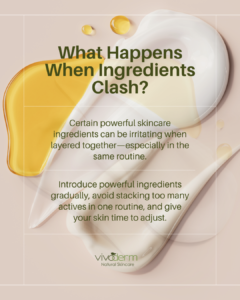
A skincare ingredient doesn’t necessarily have to be “bad” for your skin to cause a problem. Two effective ingredients may simply be too intense when used together, particularly for sensitive skin or when you’re introducing new actives.

Combining several exfoliating or high-strength ingredients in the same routine may contribute to:

  • Redness and irritation
  • Dryness or flaking
  • Increased skin sensitivity
  • Tightness or discomfort
  • Disruption of the skin’s natural moisture barrier

Your individual skin type, the strength of the formula, how frequently you use a product, and what else is in your routine all matter.

Rather than thinking of every combination as strictly “forbidden,” consider whether your skin actually needs multiple powerful actives at the same time.

Skincare Ingredients to Use Carefully Together

Retinol + AHAs or BHAs

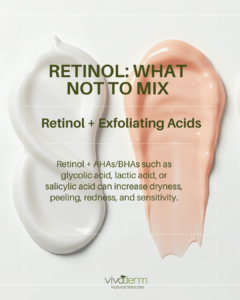
Retinol encourages skin cell turnover, while alpha hydroxy acids (AHAs) and beta hydroxy acids (BHAs) exfoliate the skin.

AHAs such as lactic acid and glycolic acid primarily work at the skin’s surface, while the BHA salicylic acid is commonly used in products designed for oily and acne-prone skin.

Each can be useful on its own, but layering retinol with strong exfoliating acids may be too aggressive for some skin types.

Better approach: Consider alternating them between different evenings rather than using everything in the same routine. Introduce new actives gradually and pay attention to how your skin responds.
AHA + BHA + Multiple Exfoliating Acids

Using several exfoliating acids doesn’t necessarily mean you’ll get faster or better results.

Combining glycolic acid, lactic acid, salicylic acid, exfoliating toners, peels, and scrubs can result in over-exfoliation. Instead of smoother skin, you may end up with dryness, redness, irritation, or increased sensitivity.

Better approach: Choose an exfoliating product that addresses your skin’s needs and avoid stacking multiple exfoliants simply because they are available.

Retinol + Benzoyl Peroxide

Both ingredients are frequently found in acne and anti-aging routines, but using them together may be unnecessarily drying or irritating for some people. Depending on the formulations involved, benzoyl peroxide may also affect the stability of certain forms of retinoids.

Better approach: If you use both, consider separating them—for example, one in the morning and the other in the evening—or follow the directions provided with your specific products.

Vitamin C + Strong Acids

Vitamin C and exfoliating acids can both be valuable additions to a skincare routine. However, layering a potent Vitamin C formula with strong AHAs or BHAs may increase irritation, particularly for sensitive skin.

Better approach: Try using Vitamin C during your morning routine and exfoliating acids at night or on alternate days.

And remember: daily sunscreen is especially important when using ingredients that can increase sun sensitivity.

Can You Use Too Many Skincare Products?

Yes. Even when individual products are appropriate for your skin, a complicated routine can become too much.

Layering multiple serums, exfoliants, oils, creams, masks, and treatments may contribute to irritation, clogged pores, product buildup, or a heavy, congested feeling.

It can also make troubleshooting difficult. If your skin suddenly becomes irritated and you’ve introduced four new products, how do you know which one caused the reaction?

A better skincare routine isn’t necessarily the one with the most steps. It’s the one that gives your skin what it needs without unnecessary overload.

How to Layer Skincare Products Correctly

Once you’ve selected products that are appropriate for your skin, application order matters.

A helpful general rule is:

Apply products from thinnest to thickest, with sunscreen as the final step of your morning routine.

A basic routine may look like this:

1. Cleanser
Begin with a gentle cleanser to remove makeup, excess oil, dirt, and impurities.

2. Toner
Apply toner after cleansing to refresh and prepare the skin for the products that follow.

3. Serums and targeted treatments
Lighter, water-based products and targeted treatments are generally applied before heavier moisturizers.

4. Eye cream
Apply your eye treatment gently around the delicate eye area according to the product directions.

5. Moisturizer
Choose a moisturizer based on your skin type and current needs.

6. Sunscreen — daytime
Finish your morning routine with broad-spectrum sun protection.

Always check the directions for individual products, as certain treatments may require a different application order.

Keep Your Skincare Routine Balanced

A good skincare routine doesn’t have to be complicated.

For many people, the foundation is simply cleanse, hydrate, moisturize, and protect, with targeted treatments added when needed.

At Vivoderm Natural Skincare, you can build a routine around your individual skin type rather than adding unnecessary steps.

For example:

  • Vivoderm Gentle Facial Cleanser – A gentle starting point for removing impurities without relying on harsh cleansing ingredients.
  • Vivoderm Facial Toner with Grape Seed & Green Tea – An alcohol-free toner that helps refresh, hydrate, and prepare the skin for the next steps in your routine.
  • Vivoderm Anti-Aging Daily Moisturizer – A lightweight, oil-free option for normal, sensitive, and combination skin.
  • Vivoderm Intense Moisturizer – A richer moisturizing option for very dry, dehydrated, or mature skin.
  • Vivoderm Zinc Repairing Facial Cream – A targeted option for oily, combination, and acne-prone skin.
  • Vivoderm Anti-Wrinkle Eye Cream – Provides moisturizing care specifically for the delicate eye area.
  • Vivoderm Herbal Facial Masks – Weekly treatments that can be incorporated into your routine without turning every day into an intensive treatment day.

The goal isn’t to use every product at once. Choose products that serve a purpose for your skin.

Introduce New Skincare Ingredients Gradually

When adding a new active ingredient or treatment to your routine, give your skin time to adjust.

Instead of changing several products at once:

  • Introduce one new product at a time.
  • Follow the recommended directions and frequency.
  • Avoid immediately combining multiple strong actives.
  • Watch for persistent redness, dryness, burning, or excessive peeling.
  • Reduce frequency or discontinue a product if significant irritation develops.
  • Use sunscreen consistently during the day.

This approach also makes it much easier to identify which products your skin responds to best.

Your Skin Doesn’t Need Everything at Once

Skincare trends can make it seem like an effective routine requires numerous serums, acids, treatments, and complicated layering combinations. It doesn’t.

The best skincare routine is one you can use consistently and comfortably.

Choose products suited to your skin type, be cautious about combining powerful active ingredients, layer products in the proper order, and give your skin time to respond before adding something new.

Simple, consistent skincare can often accomplish more than an overloaded routine.

Maintain Your Winter Skincare Routine While Traveling

Written by Rachelle at Vivoderm on . Posted in Recent Articles, Seasonal Skincare, Skincare, Uncategorized

How to Maintain Your Winter Skincare Routine While Traveling for the Holidays – (and some packing tips!) 

Traveling during the holidays is always an adventure—the good, the chaotic, and the sometimes sticky (more on that in a moment). As someone who is absolutely committed to keeping their skin hydrated and happy during the colder months, I’ve had my fair share of skincare mishaps on the road. From leaking products in my suitcase to trying to explain a bottle of toner to a perplexed customs officer, I’ve learned a lot about maintaining a winter skincare routine while traveling.

Here are my tips, along with some personal anecdotes to make you laugh and (hopefully) prepare you for your holiday travels or your next trip!

Pack Smart (and Leak-Proof!)

Let me start with a cautionary tale: once, I packed my favorite moisturizer in its original jar without securing the lid properly. By the time I unpacked, my clothes were “moisturized”, and I was left with an empty jar and a suitcase that smelled faintly of lavender for weeks. Lesson learned! Now, I decant all my liquids and creams into travel-sized, leak-proof containers. To be extra safe, I seal each container in a small plastic bag or secure them all in a plastic cosmetic bag.

Pro Tip: Invest in reusable silicone travel bottles or jars. They’re lightweight, eco-friendly, and much less likely to spill than standard packaging.

Keep Your Routine Minimal

When space is limited, you don’t need to pack every serum and mask you own. Focus on the essentials for your winter skincare routine:

  • A gentle cleanser (For me, the Vivoderm Cream Cleanser, of course!)
  • A hydrating toner or essence
  • A rich moisturizer
  • Sunscreen (yes, even in winter!)
  • A travel-friendly sheet mask for an extra boost of hydration after a long flight

During one particularly hectic trip, I skipped packing toner and regretted it almost immediately. My skin was dry and flaky by day two. Now, I use a travel-sized hydrating mist that doubles as a toner and fits snugly into my carry-on. I always use my toner-spritzer on the plane to combat the dry cabin air and when at my destination for extra skin freshening

Beware of Airplane Air

If you’ve ever emerged from a flight feeling like a raisin, you know what I’m talking about. Airplane cabins are notorious for low humidity levels, which can wreak havoc on your skin. Before boarding, I apply a layer of moisturizer, and during the flight, I use a hydrating mist when I go to the restroom (you don’t want to annoy your seatmates). I also avoid wearing makeup on travel days—foundation and dry cabin air are not a good mix.

One time, I thought I could sneak in a sheet mask mid-flight. Let’s just say my seatmate wasn’t prepared for the horror-movie vibes. Now, I save those for the hotel. If you have a row all to yourself – go for it!

Don’t Forget Your Lips and Hands

Winter air is particularly brutal on lips and hands, so I always pack a nourishing lip balm and a small tube of hand cream. These items are travel-friendly and can save you from painful chapping. I’ve even used natural lip balm on the go for emergency dry patches on my face and to remove mascara smudges. Multitasking for the win!

 Navigating Customs with Skincare Products

Here’s where things can get tricky. On one trip, I was pulled aside because my carry-on was “loaded with a suspicious liquid in a 4 oz bottle.” Ugh. In my defense, it was just skincare! Thankfully, I actually had an extra empty travel tube with me, and I sat there in customs filling my travel bottles in front of them, to prevent trashing my favorite lotion. To avoid this hassle, make sure all your liquids are under 3.4 ounces (100 ml) and fit into a clear, quart-sized bag. If you’re checking your bag, you’ll have more flexibility, but double-check international regulations if you’re traveling abroad. Some countries have strict rules about bringing in botanical-based products.

Hydrate Inside and Out

Staying hydrated isn’t just about what you put on your skin. Travel can throw off your usual routines, so I make an effort to drink plenty of water, especially on flights. I also try to eat water-rich foods like oranges, salads and cucumbers to keep my hydration levels up.

Adapt to Your Destination’s Climate

Whether you’re heading to a snowy cabin or a warmer winter escape, adjust your routine accordingly. For colder destinations, focus on heavy moisturizers and oils. For milder climates, you can stick to lighter products but don’t skimp on hydration.

During a recent trip to Colorado, I underestimated how dry the mountain air would be. The Daily Moisturizer is usually perfect for my normal skin, but there, my skin felt tight and uncomfortable. Now I include the Vivoderm Intense Moisturizer into my high-altitude routine. Always research the climate and humidity of your destination and pack accordingly.

Final Thoughts

Traveling during the holidays doesn’t mean sacrificing your skincare routine. With a little preparation and the right products, you can keep your skin happy and hydrated, no matter where the season takes you. And if you do have a mishap—like spilling toner all over your toiletries—just remember to laugh it off. After all, the holidays are about making memories, and sometimes, the funniest ones happen when things don’t go as planned.

The Benefits of Willow Bark for Skincare

Written by Rachelle at Vivoderm on . Posted in Acne, Anti-Aging, Ingredients, Natural Skincare, Recent Articles, Uncategorized

Dr. Adhami chose Willow Bark Extract as one of the very first (strongest) herbal ingredients in the Vivoderm Facial Toner.

Willow bark extract, derived from the bark of various willow trees, has been used for centuries for its medicinal properties. In recent years, it has gained popularity in the skincare industry due to its numerous benefits. Here’s a closer look at why willow bark extract is a valuable addition to your skincare routine.

1. Natural Exfoliation Willow bark extract contains salicin, a natural source of salicylic acid, which is known for its exfoliating properties. It helps to gently remove dead skin cells, promoting a smoother and more radiant complexion. This natural exfoliation process can help to unclog pores and prevent acne breakouts.

2. Anti-Inflammatory Properties
One of the standout benefits of willow bark extract is its anti-inflammatory properties. It can help to reduce redness and irritation, making it an excellent choice for those with sensitive or acne-prone skin. The anti-inflammatory effects can also soothe conditions like eczema and rosacea.

3. Antioxidant Benefits
Willow bark extract is rich in antioxidants, which help to protect the skin from environmental stressors such as pollution and UV radiation. These antioxidants can neutralize free radicals, preventing premature aging and promoting a youthful appearance.

4. Oil Control
For those with oily skin, willow bark extract can be particularly beneficial. It helps to regulate oil production, reducing the appearance of oily skin and minimizing the formation of blackheads and whiteheads. This makes it a great ingredient for maintaining a balanced complexion.

5. Anti-Aging Effects
The combination of exfoliating, anti-inflammatory, and antioxidant properties makes willow bark extract a powerful anti-aging ingredient. It can help to reduce the appearance of fine lines and wrinkles, improve skin texture, and promote a more youthful complexion.

6. Gentle on the Skin
Unlike some harsher chemical exfoliants, willow bark extract is gentle and suitable for most skin types, including sensitive skin. It provides effective exfoliation and anti-aging benefits without causing irritation or dryness.

How to Use Willow Bark Extract in Your Skincare Routine
Willow bark extract can be found in various skincare products, including cleansers, toners, serums, and moisturizers. To incorporate it into your routine:

Cleanser: Use a willow bark extract-infused cleanser to gently exfoliate and cleanse your skin.

Use the Vivoderm Facial Toner: with willow bark extract to balance your skin’s pH and prepare it for the next steps.

Serum: Use a serum containing willow bark extract to target specific skin concerns like acne or aging.

Moisturizer: Finish with a moisturizer that includes willow bark extract to lock in hydration and provide ongoing benefits.

As you can see, willow bark extract is a versatile and effective ingredient that offers numerous benefits for the skin. From gentle exfoliation and anti-inflammatory properties to antioxidant protection and oil control, it can help to improve the overall health and appearance of your skin. Whether you have sensitive, oily, or aging skin, incorporating willow bark extract into your skincare routine can lead to a clearer, smoother, and more radiant complexion.

FAQ

Should I wear sunscreen while using willow bark extract?

While sunscreen should be a regular part of your skincare routine, it’s especially important to use with any sort of exfoliating ingredient, including willow bark extract.

How often can I use willow bark extract in my skincare routine?

Unlike salicylic acid, willow bark extract is gentle enough to be used daily.

What skin types are best suited for willow bark extract?

Willow bark extract is a great ingredient to use for oily, acne-prone, and sensitive skin.


Learn more about the benefits of all our ingredients and great skincare tips by following us on Facebook and Instagram!